
Mesh
Building license verification can make sense when your platform has limited jurisdiction and trade coverage, reliable access to authoritative source data, predictable verification requirements, and a team responsible for ongoing maintenance. Buying becomes more attractive as coverage expands, vendors hold multiple licenses, and monitoring or exception handling begins competing with the core product roadmap.
The decision should compare total operating cost and verification quality, not just initial integration effort. An internal system must account for source access, data normalization, vendor-to-license matching, monitoring, maintenance, exception handling, and the engineering work displaced from the core product roadmap. This guide explains those costs and provides a practical framework for deciding which model fits your platform.
This guide is for CTOs, engineering leaders, and operations managers at vendor compliance platforms that help property managers vet and manage contractors. The central question is which parts of license verification your team should build and maintain internally, and which parts are better handled by a specialized provider.
Build vs. buy scorecard
If most of your answers land in the right column, buying may reduce total operating cost, maintenance burden, and time diverted from the core product roadmap. Validate the decision using the same coverage, verification volume, monitoring requirements, and service expectations.
|
Question |
Build makes sense |
Buy makes sense |
|
How many states are your vendors in? |
One or two |
Many, and growing |
|
Licenses per vendor |
Usually one |
Often two or more |
|
Turning down new business due to operational constraints |
Operations team is not a rate-limiter |
Unable to sell license verification due to constraints |
|
When do you check? |
Onboarding only |
Onboarding plus ongoing monitoring |
|
Other checks you run (TIN, SOS, OFAC, registry) |
None, or one stable vendor |
Several separate integrations |
|
Engineering capacity |
Spare headcount for a data team |
Roadmap already full |
|
Who owns scraper breakage? |
A named team with time for it |
"Whoever built it" |
|
Who owns data acquisition? |
Operate only in “easy” states and jurisdictions |
Complicated purchases or FOIA requests necessary to expand coverage |
|
Statuses and license types to normalize |
A few dozen, from boards you know well |
Hundreds of statuses and thousands of type strings |
How to compare total operating cost
Compare build and buy costs over the same period, verification volume, jurisdiction coverage, monitoring cadence and service requirements.
Building costs include data acquisition, source integrations, normalization, matching logic, monitoring infrastructure, maintenance, incident response, manual review and the opportunity cost of engineering work displaced from the core roadmap.
Buying costs include implementation, usage and monitoring fees, internal review, uncovered jurisdictions, vendor management and potential switching costs.
The economically preferable model is the one that meets the required coverage and verification quality at the lower total operating cost—not necessarily the option with the lower initial integration expense.
Why a license verification prototype understates maintenance
Because license information is generally available from public agencies, an initial prototype can appear straightforward. Agencies such as Florida’s Department of Business and Professional Regulation and California’s Contractors State License Board provide online records that can support automated or assisted lookups. A capable engineering team may be able to build initial coverage for a small number of known jurisdictions relatively quickly.
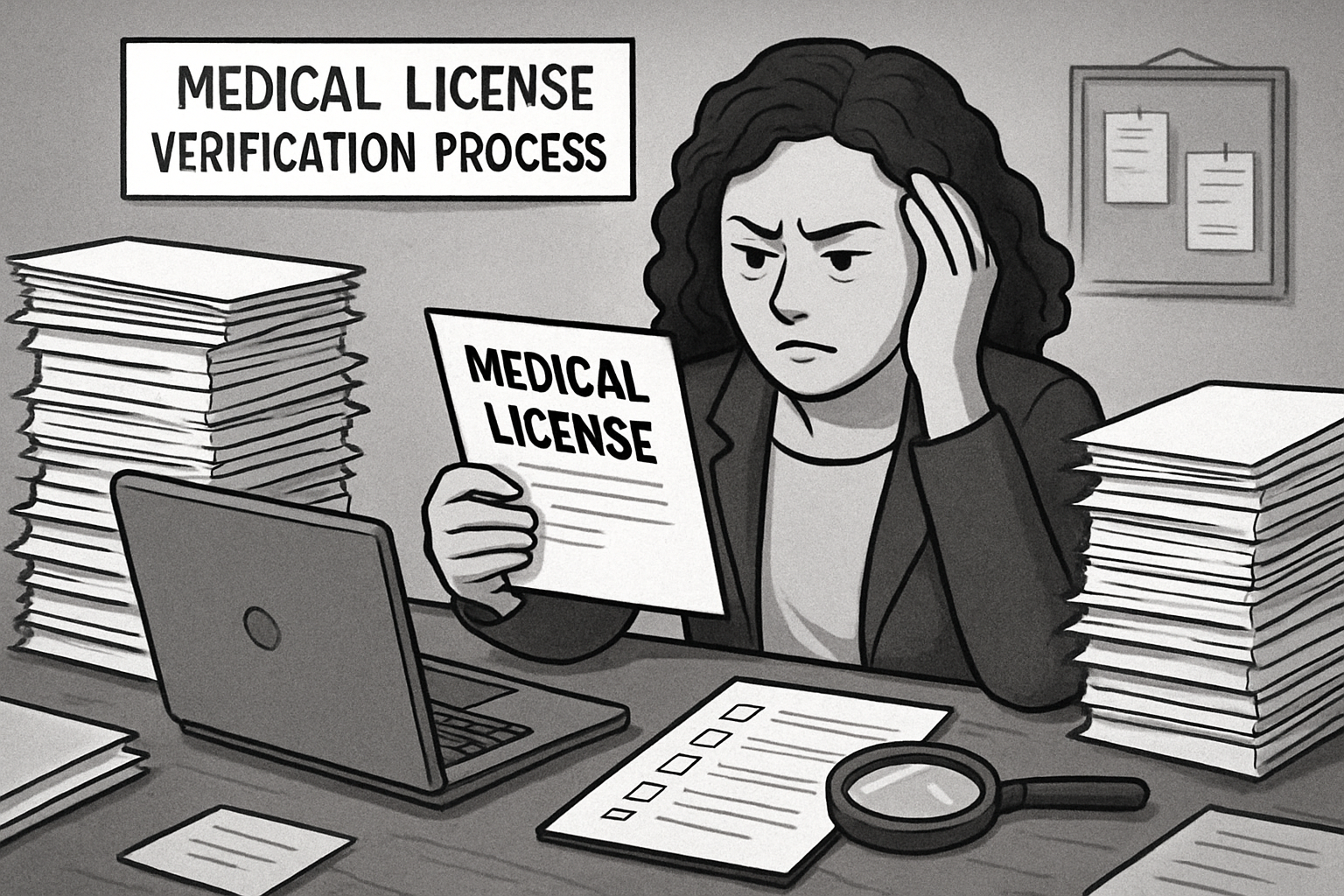
The prototype does not represent the full operating requirement. Complexity increases as the platform adds jurisdictions, trades, license types, monitoring requirements, and records that cannot be matched automatically. A basic document-driven workflow often looks like this:
• A vendor submits license information or uploads a supporting document during onboarding.
• An operations reviewer searches the relevant issuing authority and compares the source record with the submitted information.
• The reviewer records the license type, jurisdiction, status, expiration date, source and retrieval date.
• The platform schedules another check according to its policies, contractual obligations, risk level and the expected freshness of the source.
• If the license changes between checks, the platform may continue relying on a status that is no longer current.
An initial integration or scraper may accelerate individual lookups, but it does not resolve source changes, status normalization, vendor-to-license matching, monitoring or exceptions. Each additional jurisdiction and trade introduces new data structures, terminology and maintenance requirements.
Why license verification complexity grows with coverage
Each additional jurisdiction introduces new sources, terminology, matching rules and maintenance requirements. The operating burden generally falls into four areas: data access, normalization, vendor-to-license matching, and ongoing monitoring.
Data access and changing sources
Each issuing authority functions as a separate data source. License numbers, classifications, status labels, search requirements and page structures vary by jurisdiction and trade. Credentials may be issued at the state, county, municipal or federal level. As coverage expands, the platform must maintain more source connections and understand what each source does—and does not—confirm.
Many agency lookup portals were designed for individual searches rather than high-volume verification. Required inputs vary, and portals may use CAPTCHAs, strict matching, license-type selectors or number formats that include prefixes and leading zeros. A license number may also repeat across categories, creating the possibility of a technically valid but incorrect match.
Automation therefore requires more than submitting a number to a website. It must accommodate source-specific rules, schema changes, outages, retries and records that cannot be resolved confidently.
License status and trade normalization
Licensing authorities do not use a shared status vocabulary. Across 12 Mesh licensing-data studies, Mesh identified 368 raw status strings from issuing authorities.¹ These values included suspension categories, abbreviated codes, dates entered as statuses and text containing hidden formatting characters. A platform must translate those source values into consistent internal outcomes without discarding the underlying status or its source context.
Even one authority may represent the same status differently across its website, glossary and downloadable files. For example, a public lookup may describe a license as current and active while the corresponding file uses a value such as “CLEAR.” Normalization must preserve the original value while applying a documented interpretation.
Example Dispositions and Their Implications for Vendor Compliance
|
What the source reports |
What the platform must determine |
|
Clear |
Whether the source treats “clear” as current and whether the license covers the requested work |
|
Active in renewal |
Whether the authority provides a renewal or grace period and whether policy permits acceptance |
|
Active - past disciplinary action |
Whether the license remains current and whether the history requires review under policy |
|
Clear but inactive |
Whether the credential is currently valid for the requested activity |
|
Bond suspension |
Whether the suspension has been resolved and the authority has restored the license |
|
Expired |
Whether the credential was renewed, remains within an applicable grace period or is no longer current |
These examples illustrate why source status alone may not determine whether a vendor is authorized for specific work. The final decision depends on the issuing authority’s rules, the applicable trade and jurisdiction, and the platform’s own policy.
License classifications also vary across jurisdictions. Mesh catalogued 3,523 raw license-type strings across the U.S. and Canada during the period described in the methodology section.¹ The same code can represent different trades in different states, and individual sources may format similar codes inconsistently. These values must be mapped to normalized categories before a platform can determine whether a license covers the work being performed.
A single license may contain several trade classifications. Confirming that the license is current does not establish that it authorizes the specific work under review. The verification workflow must also identify the applicable classifications and apply the platform’s policy for that trade and jurisdiction.
Vendor to license matching
Names are not reliable unique identifiers. In a Mesh analysis of 62 rosters across 28 jurisdictions, 1,448 license records were associated with the name James Smith.¹ Name-and-state matching alone can attach the wrong license—or the wrong adverse status—to a vendor.
Source records do not always contain the fields needed to resolve ambiguity. In a Mesh review of 243 U.S. bulk files, 130 lacked a usable license-type field.¹ When classification, address or other identifying information is absent, the system must use additional evidence or route the record for review rather than infer a definitive match.
Some license numbers don't stay put. Arkansas's Contractors Licensing Board issues a new license number every renewal cycle. The last four digits encode the expiration month and year, so 0397731025 becomes 0397731026 on renewal. Across one renewal cycle of that roster, 757 of the 17,405 contractors present in both snapshots came back with a different number. A single license record can also carry a trailing history of dozens of prior entries, and your parser has to find the one that's current. Key your vendor on last cycle's number and a licensed contractor looks unlicensed.
Limited shared data reduces matching confidence. Records that cannot be connected to the correct business or professional with sufficient evidence should be treated as unresolved—not automatically verified or rejected.
Absence from a bulk file is not conclusive evidence that a license never existed. Some authorities publish only active licenses or remove records after a defined period of inactivity. When a vendor is missing, the system may need another authoritative source or additional evidence to determine whether the license expired, was revoked, was removed from the file or never existed.
Vendors may hold multiple licenses across trades and jurisdictions. The system must associate those credentials with one vendor record and apply the platform’s policy when individual licenses have different statuses. It is not uncommon for vendors to work across state lines and hold licenses in one or more states.
Submitted information may not match source records. Vendors type their federal tax ID into the license number field. The DBA on your form doesn't match the licensee name on the board. A system that expects exact, correctly formatted inputs may return “not found” even when a valid license exists, creating additional exceptions for review.
Monitoring and exception handling
A point-in-time check and an ongoing monitoring system have different operating requirements. Monitoring requires scheduling, retries, source-change detection, status comparison, evidence retention and a defined alert path into the customer’s workflow. Records affected by outages, ambiguous matches or incomplete source data also need an explicit exception process.
The build decision should therefore include long-term ownership. Before building, identify which team will maintain source connections, normalization rules, matching logic, monitoring infrastructure and exception workflows after the initial implementation.
Data access and freshness
License-verification data is not available through one consistent acquisition method. Depending on the issuing authority, a platform may need to use bulk files, negotiate subscriptions with agencies, public-records requests, portal lookups, or support manual retrieval. Each source also has its own access restrictions, refresh cadence, and failure modes.
-
Records requests. Some licensing authorities do not publish bulk data, requiring a formal public-records request or another approved acquisition process.
-
Bot walls. In a September 2026 Mesh sample of 34 contractor-license sources, nine blocked scripted access and required retrieval through another supported method.¹
-
Uneven refresh. Those 34 sources refreshed on schedules ranging from daily to annual, while others published updates irregularly or replaced the complete file during each refresh.
-
Boards go down. During the 12 months ending September 15, 2026, Mesh’s operations team recorded 102 outages and maintenance windows across 54 licensing authorities.¹ A verification system must distinguish an unavailable source from a genuine “not found” result.
Public records requests are slow and uneven
Public-records requests can involve eligibility restrictions, request specifications, processing fees, delivery delays, and incomplete results. The process varies by jurisdiction and issuing authority, so it should be treated as an ongoing data-acquisition function rather than a one-time integration task.
-
Eligibility: Some jurisdictions restrict who may submit a request or require additional documentation for commercial use.
-
Cost: Charges may include per-record fees, staff time, file preparation, or delivery expenses.
-
Precision: An incorrectly scoped request can return incomplete or unusable records and require the request to be submitted again.
-
Delivery: Response times and formats vary, and the resulting file may still require normalization and quality review.
What AI agents can (and cannot) automate
-
Consistent reliability. AI agents can automate parts of license-data retrieval and processing, but an agent acting alone cannot provide reliable verification across many licensing authorities. It still requires authorized source access, maintained status and trade mappings, retry logic, source provenance, and an exception-handling process.
-
Access restrictions. An AI agent encounters the same CAPTCHAs, session controls, usage restrictions, and unavailable sources as other automated retrieval methods.
-
Maintained interpretation. Reading a result is different from interpreting it correctly. Status terminology, trade classifications, license structures, and field definitions vary by jurisdiction and must be mapped and kept current.
AI can improve retrieval and processing within a maintained verification system. It does not eliminate the underlying work of source acquisition, normalization, monitoring, and exception handling.
How other vendor checks affect build vs. buy
License verification is rarely the only external check in a vendor-compliance workflow. Platforms may also verify tax identity, entity standing, sanctions exposure, or other policy-driven requirements. Each additional check creates its own source-access, integration, normalization, retry, evidence, and exception-handling requirements.
|
Check |
Decisions supported |
Operational considerations |
|
TIN verification |
Do the submitted tax ID and legal name align with available authoritative records? |
Source availability, retry handling, sole-proprietor identity patterns, and mismatches requiring review |
|
Secretary of State standing |
Is the business registered and is its recorded status current in the relevant jurisdiction? |
Formation-state versus operating-state requirements and inconsistent status terminology |
|
OFAC and watchlists |
Does the business or a relevant person match applicable sanctions or watchlist records? |
Fuzzy matching, false positives, adjudication, and evidence retention |
|
Sex offender registry |
Is a covered owner or technician listed when the platform’s policy requires this check? |
Policy scope, permissible use, identity resolution, and jurisdictional variation |
These checks should be evaluated as a portfolio rather than as isolated integrations. For each one, compare the cost of maintaining source access, authentication, decision rules, retries, evidence, and review workflows with the implementation, usage, coverage-gap, and switching costs of a provider. Consolidating checks through one provider can reduce integration overhead, but it should not be assumed to lower total cost or eliminate exceptions.
What a purchased license verification API should return
A purchased license-verification API should return normalized evidence and decision-ready outcomes while clearly identifying the source, retrieval time, matching result, and any unresolved conditions. Buyers should also understand how the provider acquires and maintains its data because coverage may combine bulk files, portal lookups, direct source connections, and operations support.
|
928 licensing boards and agencies we work with data from |
80,148,246 Records maintained |
~15 sec for most results, with adjudication for the hard ones |
Mesh works with data from 928 licensing boards and agencies through this mixed acquisition model. In one internal bulk-data snapshot, Mesh downloaded and normalized 80,148,246 rows from 237 rosters.¹ These figures describe Mesh’s source network and one data sample; they do not mean that every license is available from every source at all times.
When a source is unavailable or the submitted information cannot be matched confidently, the API should return a pending or reviewable outcome rather than interpreting missing data as evidence that the vendor is unlicensed.
What comes back:
-
A result for each check: Pass, Needs review, or Fail based on the customer’s configured rules.
-
Source evidence: The issuing authority, original source status, normalized status, and retrieval time.
-
License details: The license number, licensee name, classification, jurisdiction, status, and expiration date when available.
-
Match evidence: The fields used to connect the license to the submitted vendor or professional.
-
An exception reason: A clear explanation when a source is unavailable, the record is incomplete, or the match remains uncertain.
-
Associated credentials: Multiple licenses can be connected to the same vendor record without implying that every credential has the same status.
Monitoring cadence should be determined by the platform’s policies, contractual obligations, risk model, and the freshness of the underlying source. A provider should support scheduled rechecks and defined alerts while allowing the customer to determine which status changes can be handled automatically and which require review.
How one credentialing platform runs it
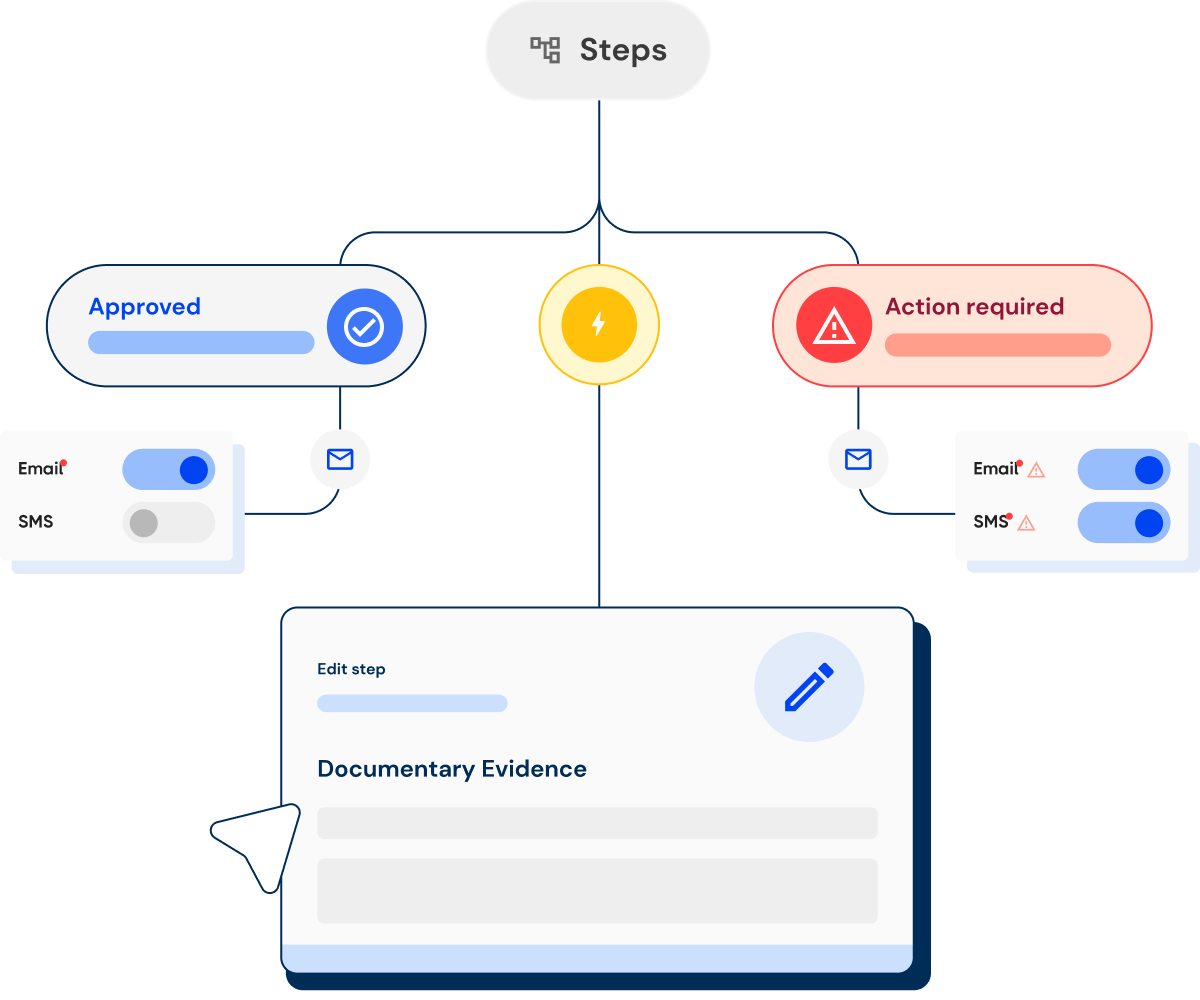
In one Mesh deployment with a property-management credentialing platform, selected vendor checks are submitted through a single integration. Results that satisfy the customer’s configured rules can proceed automatically, while uncertain or conflicting results create a ticket in the customer’s existing system for review.
Implementation focused on translating the customer’s policies into decision rules and exception workflows. The customer retains control over which checks run, which outcomes can proceed automatically, and which conditions require human review.
When building license verification may be the better choice
Building can be the better choice when the required coverage is limited and stable, source data is accessible, and the organization has a team responsible for ongoing maintenance. A purchased verification service may also be incomplete for the following requirements:
-
You require a stored license document. Mesh returns license status and available issuing-authority records rather than an image or PDF of the license. Platforms that must retain the original credential should continue collecting documents alongside any verification process.
-
You need a licensing-requirements matrix. License verification determines whether a submitted or discovered credential is associated with the relevant business or professional and what status the issuing authority reports. It does not independently determine which licenses a vendor is legally required to hold for every trade, service, and jurisdiction.
-
Your verification scope is limited and operationally stable. Building may be economical when the platform supports a small number of jurisdictions and trades, the required source data is consistently accessible, and an internal team can maintain integrations, mappings, monitoring, and exception workflows. The decision should be based on total operating cost rather than geography alone.
Frequently asked questions about building or buying license verification
What does in-house license verification cost to maintain?
The cost of building license verification extends beyond the initial integration. It includes source acquisition, data licensing or records-request fees, normalization, vendor-to-license matching, monitoring infrastructure, source maintenance, exception handling, manual review, and the opportunity cost of engineering and operations time. A fair build-versus-buy comparison should measure these costs over the same period and verification volume while also accounting for the provider’s implementation fees, usage charges, coverage gaps, internal review requirements, and switching costs.
What is the difference between license verification and a licensing-requirements matrix?
License verification determines whether a specific credential exists, whether it matches the relevant business or professional, and what status the issuing authority reports. A licensing-requirements matrix determines which credentials are required for a particular trade, service, jurisdiction, or scope of work. A provider may perform license verification without determining every license the vendor is legally required to hold.
How should platforms handle unavailable boards or stale license data?
An unavailable source should not automatically produce a “not found” or unlicensed result. The system should identify the source as unavailable, preserve the date and provenance of the last successful record, retry according to a defined policy, and route unresolved cases appropriately. Whether previously retrieved evidence remains usable should depend on the platform’s policies, contractual obligations, risk model, and the age of the data.
How should a platform evaluate a license-verification provider?
Test each provider using the same representative sample of vendors, jurisdictions, trades, and difficult records. Measure resolution rate, vendor-to-license matching accuracy, source provenance, data freshness, turnaround time, outage handling, exception volume, review workload, and total operating cost. Buyers should also distinguish between the number of sources a provider accesses and the licenses it can currently verify for the platform’s actual vendor population.
Test the build-versus-buy decision using your own vendor data
The most reliable way to evaluate build versus buy is to test both approaches against the same representative vendor sample. For a Mesh evaluation, select 150 vendors across the jurisdictions, trades, license types, and exception patterns your platform encounters. Include straightforward records, multi-license vendors, and cases that have previously required review. Mesh can complete the evaluation under a mutual NDA and return:
-
Resolution rate by jurisdiction, trade, and license type
-
Match evidence and source provenance for resolved records
-
Unresolved and conflicting results with the reason each case requires review
-
Turnaround-time distribution across the complete sample
-
Coverage gaps and estimated review workload
Compare those results with the in-house approach using the same records, decision rules, measurement period, and verification volume. Evaluate resolution quality, review workload, maintenance requirements, and total operating cost before deciding which approach is the better fit.









 LinkedIn