Approve qualified practitioners in seconds, not days
Automate state license verification for healthcare brands, pharmacies, and practitioner-only ecommerce. Reduce manual review, stop more invalid registrations before approval, and keep compliant providers in good standing over time — without rebuilding your registration flow from scratch.








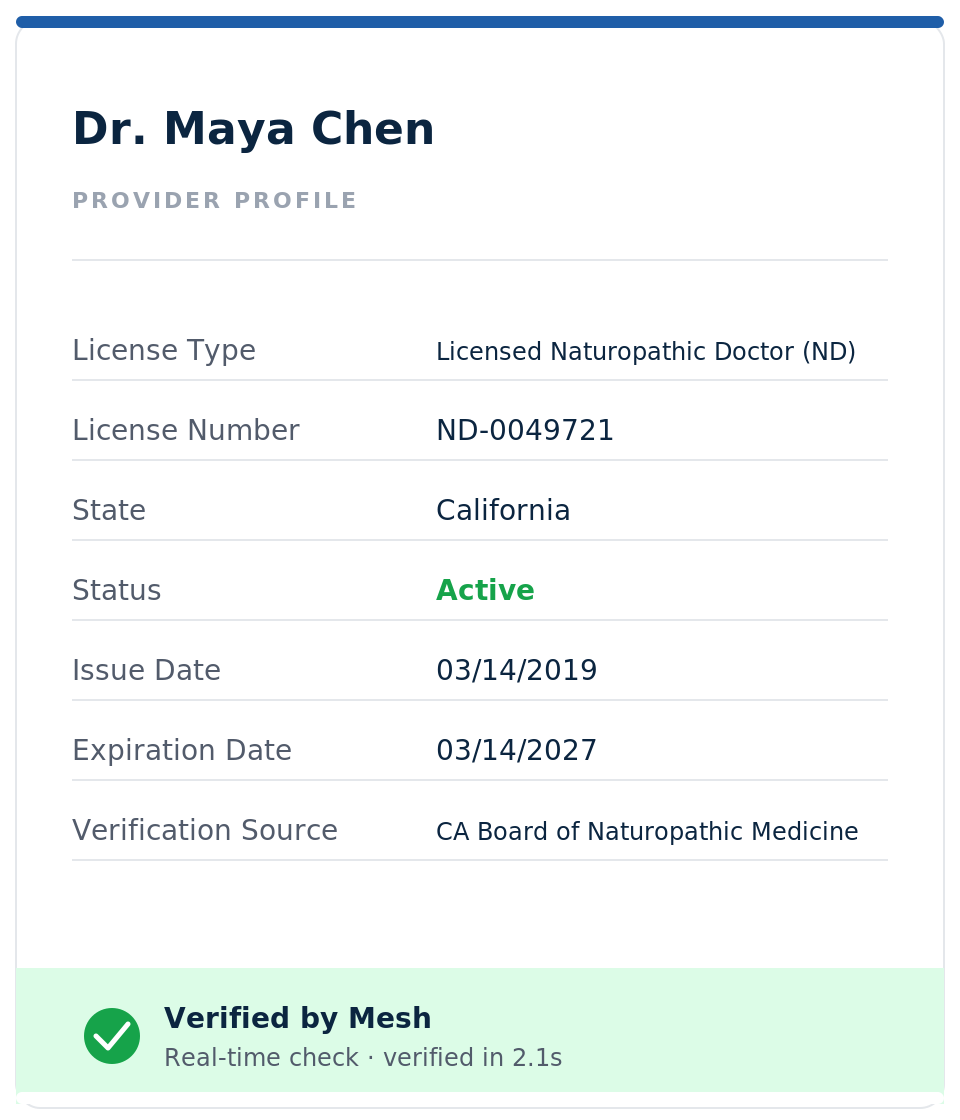
WHY HEALTHCARE ECOMMERCE TEAMS SWITCH
Manual vetting slows conversion and leaves too much judgement trapped in the queue.
The strongest healthcare onboarding experiences do not try to replace your policy. They operationalize it. Verify the practitioner, apply your business rules, preserve a fast path for clean matches, and reserve human time for the small percentage of cases that actually need review.
- Shorten time to approval
- Reduce diversion risk
- Lower customer service load
Use your current registration flow. Add a verification layer behind it.
Incorporate into your existing flow for the most practical first step for healthcare commerce: professional license verification first, approved second, and broader fraud tooling alongside the workflow where needed.

Collect
Keep your form and pass the practitioner’s name, state, license number, and supporting details through API, embedded UI, or batch.
Verify
Check against authoritative licensing boards, normalize messy inputs, and return license status, type, dates, and matching context.
Decide
Apply your rules for approved, approved with comments, or rejected. Keep internal review where you want it.
Monitor
Recheck active accounts over time so expired or changed credentials do not quietly remain approved in your system.
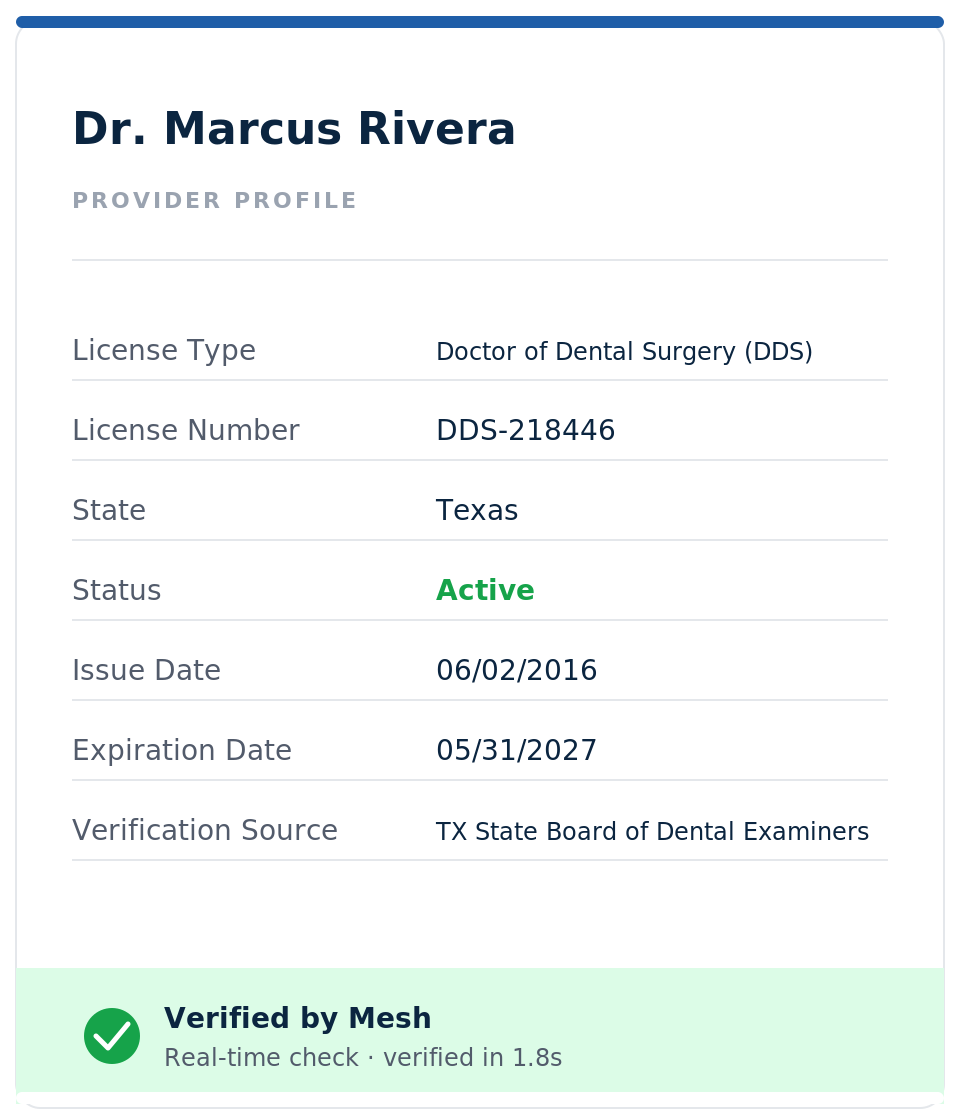
More than a binary check.
Healthcare teams often need more nuance than yes or no. The right workflow lets you auto-approve clean registrations, surface comments when there is an explainable mismatch, and keep unsupported or inactive registrations out.
- Approved - Use the fast path when the license is found, active, and aligned with your allowed provider categories.
- Approved with comments - Support high-confidence edge cases with clear labels, so teams can decide what to auto-pass and what to double-check.
- Rejected - Stop registrations when the credential is inactive, unsupported, not found, or otherwise outside your approval policy.
Start with license verification. Expand when the workflow is ready.
The strongest healthcare rollouts usually begin with the most authoritative and highest-impact signal: professional license verification. Once that layer is live, business verification and broader risk screening can be added without muddying the first deployment.
Professional license verification
Deliver immediate value where the operational burden already exists.
1. Automate state license checks
2. Apply approval rules by license type
3. Route exceptions into review
4. Monitor approved practitioners over time
Business verification and adjacent risk layers
Add more control once the organization is ready to evolve the registration experience
1. Business name and entity verification
2. TIN/Secretary of State workflows
3. Website or channel validation
4. Individual-to-business association
5. Address risk
Questions healthcare teams ask before rollout
Healthcare organizations face a unique challenge: balancing fast provider onboarding with strict compliance, credential validation, and fraud prevention. Yet most systems rely on fragmented data, manual reviews, and outdated records—creating delays, poor provider experiences, and unnecessary risk.
Do we need to replace our registration form?
No. Keep your current experience and add verification behind the scenes through API, embedded UI, or batch workflows.
Can we handle edge cases internally?
Yes. Mesh emits labels to highlight ambiguous cases for review. Clean matches can move fast, while your team keeps control of more nuanced scenarios.
Can we approve some provider types and reject others?
Yes. Customize business rules by license type, category, and approval policy rather than treating all licensed practitioners the same.

 LinkedIn