
Mesh
Most point-of-sale lenders focus on consumer underwriting while the merchant behaves as their front-line underwriter. Before you establish whether a consumer can pay, you must screen for merchants that will deliver service that will satisfy your borrowers long after the job is done. You are the bridge between the customer’s desire for a new smile, a new furnace, or a new pool and a funded job you’re willing to stand behind, so the work can start sooner rather than later. Good partners perform high-quality work. The best ones grow through word of mouth.
There is no standardized set of risk signals to draw from. Does the business have a current license? Does the applicant have the authority to apply on its behalf? Does the business have an authentic review history? Does the business have a web presence that matches its operational footprint? These signals must be painstakingly curated across a balkanized landscape of jurisdictions and sources.
Quick answers
-
What is SMB verification? It confirms the merchant’s business identity, credentials, physical address, digital footprint, and the applicant’s relationship to the business.
-
-
Why is it difficult? Risk signals are unstructured and fragmented across sources.
-
What causes manual review? Lack of information, conflicting records, weak applicant association, and stale license status.
-
How can lenders reduce fraud and friction? Decide what needs to be true, then leverage fresh data, confidence-based routing, reason codes, and efficient review practices.
-

What is merchant risk?
Merchant risk is the chance your partner fails, not the chance your borrower doesn’t pay. The law can make this your problem. Under the FTC Holder Rule (16 C.F.R. § 433.2), you inherit the borrower’s claims and defenses arising out of the work your money paid for. Affirmative recovery is capped at what the borrower paid, but the borrower can also refuse the outstanding balance. Quality service is harder to measure, but shoddy work exposes you to disputes, mediation, or worse. A dispute can harm your reputation, which may give you fewer opportunities to make a loan in the first place.
For underwriting and risk teams, this process should resolve four foundational questions:
-
1. Is this a legitimate operating business?
-
2. Is it properly registered and licensed for the activity it claims to perform?
-
3. Is the applicant genuinely associated with or authorized to represent it?
-
4. Is this application risky enough to warrant manual review?
These checks provide useful inputs to flag risks outside the consumer’s repayment capacity.
What is SMB verification?
SMB verification answers a question your credit model never asks: is the business on the other side of this application real, does it hold the credentials the work requires, and does the person signing have the authority to agree on behalf of the business?
It resolves five things from authoritative sources before you fund: business identity, physical address, digital presence, required licenses, and the applicant's relationship to the business. It combines authoritative records with unstructured data to deliver an actionable decision.
You need it because merchant risk is upstream of consumer credit risk and the law makes your partner's failure your problem.
Why is SMB verification especially difficult in 2026?
POS financing now happens inside fast-moving workflows, so identity checks must operate at application speed. U.S. Census data counted 30.4 million nonemployer establishments against 8.4 million employer establishments in 2023 — roughly 78% of U.S. business establishments have no paid employees.
Public business data remains fragmented across state registrations, local permits, professional licenses, trade names, addresses, and adverse events maintained by different authorities. No universal domestic-business record cleanly answers every identity question. FinCEN's current Corporate Transparency Act guidance states that U.S.-created entities and their beneficial owners are exempt from beneficial ownership information (BOI) reporting. BOI filings are not a universal identity source for domestic SMB applicants.
In May 2026, the Consumer Financial Protection Bureau revised its small-business-lending data rule and extended the compliance date to January 1, 2028. The practical takeaway for lenders is a greater need for nuanced, explainable decisioning data.
What are the main POS financing SMB verification challenges?
1. One business can have several valid identities
A single business can appear under several valid identities. A merchant may use a storefront name while state records use a legal entity name, licenses use an owner's name, and bank records use an abbreviated DBA. Addresses might belong to a home office, storefront, or prior location.
Strict matching misreads common formatting differences as contradictions, or sets expectations so rigid that automation rates collapse. Effective verification can resolve the many faces of the same business using advanced techniques such as normalization, regex, relationship mapping, source context, and confidence scoring.
2. Legitimate small businesses often have thin or unconventional records
Legitimate SMBs often have thin or unconventional records. Sole proprietors, new companies, mobile service providers, and microbusinesses may lack conventional commercial-bureau history or secretary of state registration. These businesses may be visible through alternative authoritative sources such as licenses, permits, tax records, or verified owner relationships.
Rigid workflows can misclassify thin-file applicants as unverifiable, creating unnecessary review or false declines. Verification must distinguish small data footprints from a fabricated identity.
3. Business existence does not prove applicant authority
Business existence does not prove applicant authority. A bad actor can use the name and registration details of a legitimate company, so verification must determine whether the applicant is an owner, officer, licensed professional, employee, or other authorized representative.
Applicant-to-business association should be evaluated as a separate control using signals such as owner or officer records, professional-license relationships, and consistent contact or address evidence. Weak or conflicting evidence should trigger step-up verification.
4. Licensing is fragmented by occupation and jurisdiction
Licensing varies by occupation and jurisdiction. Credentials may be issued at the state, county, municipal, or federal level, and the same occupation might require different licenses in different places. Verification should confirm the credential, status, licensee, jurisdiction, and relationship to the business from an authoritative source. That is a data-resolution problem, not a document-storage problem.
5. License type and status mean different things in different jurisdictions
Since January 2025, Mesh has verified over 15,000 unique license types in 600+ jurisdictions. There are many nuances, including a professional’s career progression from a journeyman to a master plumber, with multiple stops in between.
License status is not as simple as active, inactive, or not found. Status descriptions are unique to each issuing board. California Department of Consumer Affairs alone publishes 42 unique license status dispositions, and each one can be further differentiated by surety bonds, workers’ comp status, corporate registry status, and more.
Any snapshot would be dated as of the time of publishing. New license types are issued. Old ones disappear. Some jurisdictions set expiration dates decades into the future while others purge expired licenses on a 3-5 year schedule. Business records become stale. Companies relocate, licenses lapse, officers change, and legal actions are resolved. A cached record may be accurate when collected but wrong at the time of decision.
Real-time verification with normalized outputs can smash this complexity into a predictable shape that can drive real business decisions. These outputs should retain source provenance and retrieval time so lenders can distinguish current authoritative results from older secondary records. When credible sources disagree, the workflow should expose the conflict and apply policy rather than hide it inside one score.
6. Fraud controls can create false positives
Fraud controls can create false positives. A home address, new registration, limited web presence, or recent ownership change may be a risk signal, but none proves fraud on its own.
Risk teams should separate legitimate, suspicious, and unresolved applicants by combining independent signals and applying context. Hard stops should be reserved for evidence that justifies them; other cases need an explainable review or step-up path.
7. Automation needs exception paths and audit trails
Every verification program has an uncertain middle. Strong applicants can pass automatically, clearly prohibited or contradictory cases can stop automatically, and ambiguous cases require more evidence or judgment. Sending every non-match to the same queue preserves the bottleneck.
Each exception should include the failed or missing control, the evidence already checked, the confidence level, and the next best action. Reviewers should not have to repeat the full verification.
Where does business verification end and credit underwriting begin?
Business verification establishes who the business and applicant are; credit underwriting determines whether the applicant qualifies for financing. The two should exchange data, but they answer different questions.
|
Control |
What it answers |
Output |
|---|---|---|
|
Business identity / KYB |
Does this business exist, and what verified identity does it have? |
Verified identity, match confidence, reason codes |
|
Applicant association |
Is this person connected to or authorized for the business? |
Association confidence, conflict or step-up flag |
|
Licensing and compliance |
Does the business or professional hold the required current credential? |
Credential status, jurisdiction, expiration, restrictions |
|
Fraud and risk screening |
Are there material inconsistencies or adverse signals? |
Risk indicators and recommended routing |
|
Credit underwriting |
Is the applicant eligible and able to repay under the lender's policy? |
Approval, decline, terms, pricing, conditions |
Real-time KYB can reduce identity-related delays and provide stronger inputs to underwriting, but it cannot by itself turn every application into an instant, compliant credit decision.
Why does document automation alone fall short?
Document automation speeds intake, but it still starts with applicant-supplied evidence. Real-time business identity verification tests the asserted identity against current authoritative and corroborating sources.
|
Approach |
What it does well |
Where it breaks down |
|---|---|---|
|
Manual document review |
Supports nuanced judgment in unusual cases |
Slow, inconsistent, difficult to scale, vulnerable to altered or stale documents |
|
Document automation |
Accelerates intake and extraction |
Automates the artifact, not necessarily the truth of the underlying business identity |
|
Single-source database lookup |
Fast for clean, mature entities |
Misses DBAs, sole proprietors, licenses, relationships, and conflicting records |
|
Real-time identity resolution |
Connects current signals and returns an explainable confidence result |
Still requires policy thresholds, source governance, and an exception path |
Documents remain useful for exceptions; current data should verify routine facts whenever possible.
How does real-time business identity data reduce fraud and manual review?
An effective operating model separates identity resolution, policy decisioning, and human review so lenders can reduce fraud and manual review without hiding uncertainty.
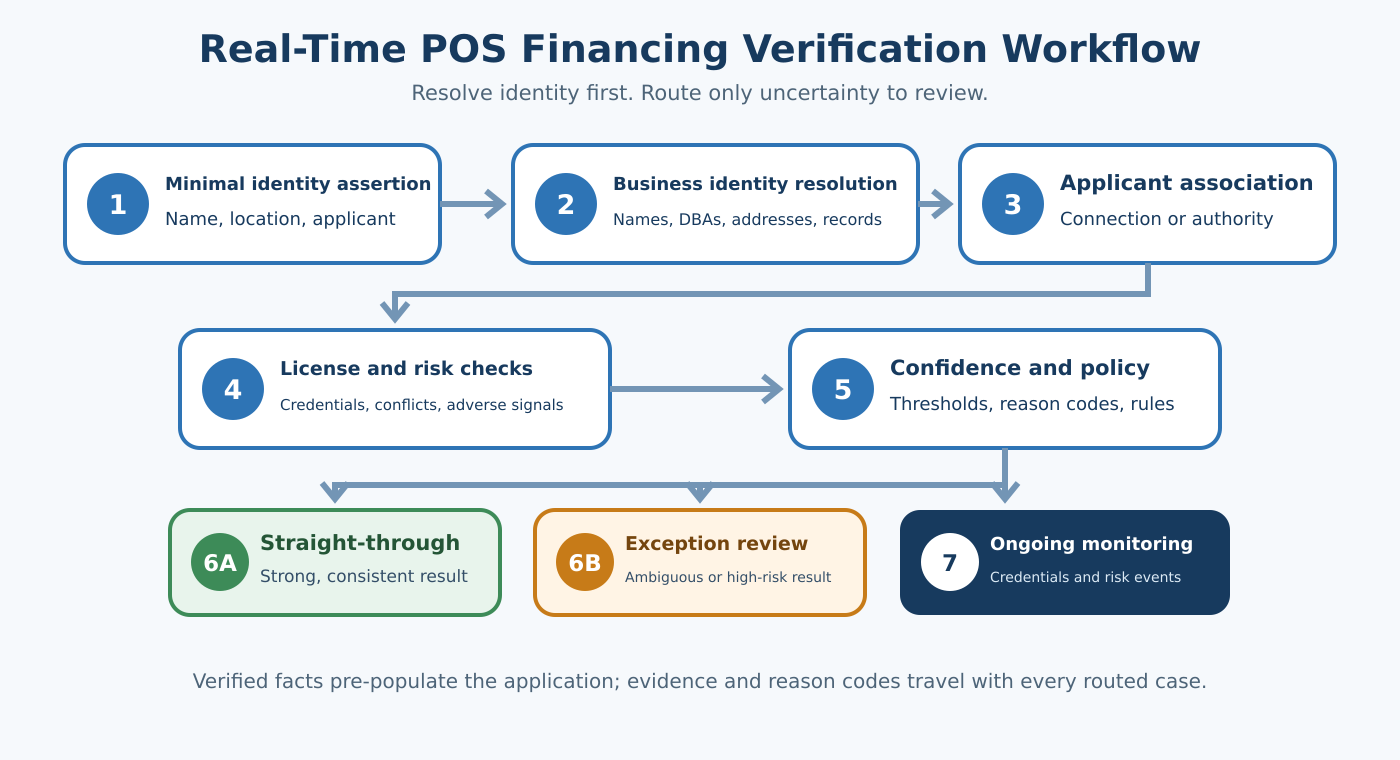
- 1. Start with a minimal identity assertion: Collect business name, location, applicant identity, and key search fields.
- 2. Resolve the business across sources: Normalize names and DBAs, connect registrations and addresses, and check licenses.
- 3. Verify the applicant relationship: Confirm credible association with the resolved business.
- 4. Pre-populate verified fields: Return confirmed data for review or correction.
- 5. Apply risk-based policy: Pass strong matches, stop disqualifying cases, and route uncertainty.
- 6. Give reviewers an evidence package: Include reason codes, provenance, timestamps, conflicts, and next action.
- 7. Monitor after onboarding: Recheck time-sensitive credentials and risk events.
Independent data checks reduce fraud by verifying core facts and the applicant-to-business relationship outside applicant-supplied documents.
Selective routing reduces manual review by sending only genuinely ambiguous cases to reviewers.
Where should humans remain in the process?
Human review is appropriate when authoritative sources conflict, applicant-to-business association is weak, a legitimate business has a thin footprint, license status is unclear, or a policy-sensitive risk event needs context. Suspected identity manipulation or material exposure may also require enhanced diligence.
Human review should resolve consequential uncertainty and policy-sensitive cases, not repeat routine registration and license checks.
How can your team benefit from automated verification?
Automated business verification can reduce onboarding delays, accelerate underwriting workflows, and allow review teams to focus on ambiguous or higher-risk cases. Production data from Mesh illustrates what this can look like in practice: median automated business verification took 6 seconds in July 2026, and two-thirds of automated verifications were completed in under 10 seconds. These results measure business verification—not the time required to make a lending decision.
This level of automation depends on connecting and resolving business, person, license, and risk records across fragmented sources. A business identity graph can preserve the relationships among those records and return supporting evidence, enabling companies to automate clear cases while directing exceptions to manual review.
What should risk teams measure?
A balanced verification scorecard should track:
1. Speed: median and high-percentile decision time.
2. Automation: straight-through verification and identity-related manual-review rates.
3. Accuracy: false-positive, false-decline, and confirmed fraud outcomes by reason code.
4. Friction: abandonment, document-request rate, reviewer handling time, and repeat work.
5. Coverage and monitoring: applicant-association and license-match success, plus material post-onboarding changes.
Segment results by entity type, industry, geography, channel, and risk tier. Portfolio averages can hide weak performance among sole proprietors and licensed professionals.
How should a POS financing provider evaluate a verification platform?
Evaluate providers against difficult applicant populations across six capabilities:
1. Coverage: Can the platform resolve legal names, DBAs, sole proprietors, and licensed professionals?
2. Applicant association: Can it verify that the applicant is connected to or authorized for the business?
3. Source quality: Are registration and license results current, authoritative, time-stamped, and traceable?
4. Explainability: Do reviewers receive confidence, reason codes, source evidence, conflicts, and the next action?
5. Policy control: Can thresholds, step-up requirements, and applicant correction paths vary by product, exposure, industry, and jurisdiction?
6. Measurement and monitoring: Can teams measure results by applicant segment and monitor material attributes after approval?
A credible proof of concept should combine difficult historical cases with a representative live sample and measure coverage, precision, review reduction, and decision latency together.
Frequently asked questions
Can POS financing SMB verification be fully automated?
No. Strong, consistent identities can pass automatically, and disqualifying cases can stop automatically, but ambiguous identities, weak applicant association, conflicting records, and policy-sensitive risk signals still require step-up evidence or human review.
Why are sole proprietors harder to verify?
Sole proprietors may operate under an owner’s name or DBA, lack separate state registration, use a home address, and have a limited commercial-data footprint. Verification must connect the person, activity, location, and relevant licenses without treating a thin file as fraud.
Does real-time data eliminate the need for documents?
No. Real-time data can eliminate unnecessary document requests when authoritative sources confirm required facts, but documents remain useful for unresolved, exceptional, or enhanced-diligence cases. The goal is document-on-exception, not document-by-default.
What is the best way to reduce manual review?
Use confidence-based routing, reason codes, and a purpose-built exception process. Verify and pre-populate facts automatically, then send reviewers only unresolved controls with the evidence already collected.
The 2026 operating principle
POS financing providers should not choose between speed and control. The scalable model is real-time verification with selective review: resolve the business, verify the applicant’s relationship, confirm relevant credentials, surface risk signals, and return an explainable result before underwriting proceeds. That changes the queue—risk teams spend less time finding facts and more time deciding what the facts mean.
Evaluate your verification workflow
See how Mesh resolves difficult SMB identities, verifies applicant associations, and isolates applications that require manual review.











 LinkedIn